
- By Brett
- In Commercial cleaning, Commercial painting, Exterior house washing, Exterior painting, Gutter cleaning, Interior painting, Pressure washing, Residential painting
Painting Cost: What a Painting Contractor Should Include in Your Estimate (and How to Compare Bids)
TL;DR: What belongs in a painter’s estimate, and how to compare bids fast
A professional painting estimate is your blueprint for the project. It should spell out the scope room by room, define surface prep standards, specify paint products down to the brand and sheen, detail the labor plan with crew size and timeline, explain protection and cleanup protocols, state warranty terms, and list exclusions like structural repairs or lead abatement. Without these elements, you can’t compare bids fairly.
Here’s what every estimate must include:
- Scope broken down by area, surface, and what’s painted or skipped
- Prep work standards with repair thresholds
- Paint system with brand, line, color ID, coats, and primer type
- Labor plan showing crew size, hours, and schedule
- Protection, masking, and cleanup procedures
- Warranty coverage and punch-list process
- Exclusions and access requirements
Three rules for apples-to-apples comparisons:
- Standardize the scope across all bids so you’re quoting identical work.
- Compare unit pricing for common extras like drywall patches or caulking to control change orders.
- Use the table below to decode line items and spot missing coats, cheaper paint, or skipped prep.
| Estimate Component | Contractor A | Contractor B | Contractor C |
|---|---|---|---|
| Paint Brand/Line | Sherwin-Williams Duration | Behr Premium Plus | Sherwin-Williams SuperPaint |
| Coats (Walls) | 2 finish coats | 1 primer + 1 finish | 2 finish coats |
| Surface Prep | Wash, scrape, sand, patch | Light sand, spot patch | Wash, caulk, prime stains |
| Crew Size/Duration | 3 painters, 4 days | 2 painters, 5 days | 4 painters, 3 days |
| Warranty | 2 years labor/materials | 1 year labor only | 3 years labor/materials |
| Per-Sq-Ft Rate | $3.25 | $2.80 | $3.60 |
The lowest number isn’t always the best deal. Missing coats or skipped prep surface as savings today but cost you twice tomorrow.
Ready to decode your stack of bids? Let’s walk through exactly what should be on the page, what swings the price, and how to catch the gaps that inflate costs later.
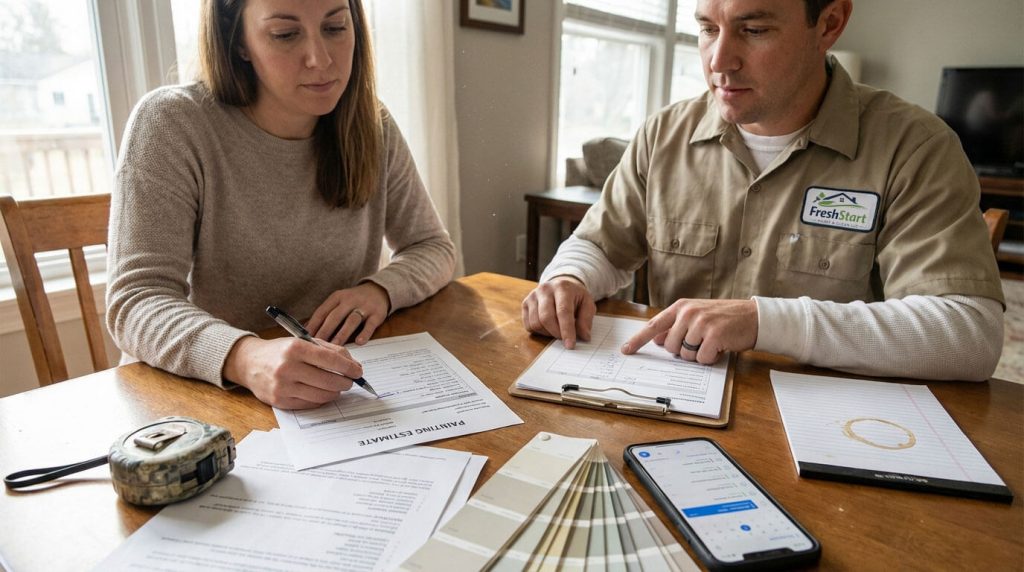
What a professional painting estimate should include
A solid estimate is a contract preview. It should read like a project manual, not a napkin scribble. Every section ties directly to the work your painter will perform, the materials they’ll use, and the standards they’ll meet. If a bid leaves you guessing, it’s incomplete.
The best estimates use plain language but keep precision high. They don’t bury details in jargon or hide behind vague terms like “all necessary work.” They spell out what happens, where it happens, and how much it costs. That transparency protects you from scope creep and gives the contractor clear marching orders.
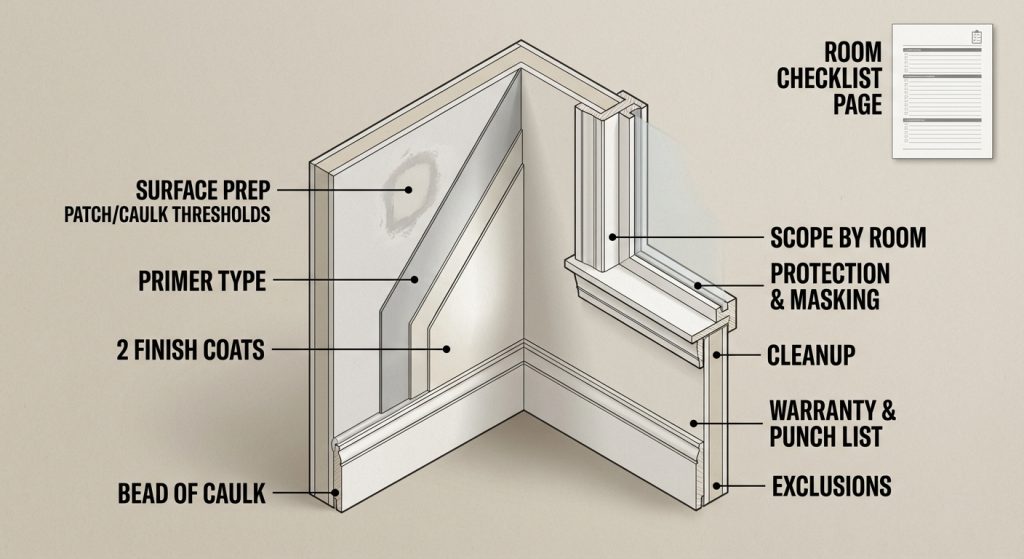
Below are the seven must-have sections. If your bid is missing any of them, ask for an addendum before you sign.
Scope of work by area/room and surface
Your estimate should name every room, list every surface, and state what gets painted and what doesn’t. A line like “Paint entire first floor” won’t cut it. You need clarity: living room walls and ceiling but not the fireplace, kitchen walls but not the cabinets, hallway trim but not the doors.
Here’s what a real scope line looks like:
“Master bedroom: two accent walls (north and west) in SW Iron Ore, remaining walls and ceiling in SW Extra White. Baseboards and crown molding in semi-gloss white. Window casings not included, existing finish to remain.”
This level of detail prevents surprises. If the painter assumes the doors are included and you assumed they weren’t, the estimate should settle it. Quantities matter too. Square footage, linear feet of trim, door count. These numbers let you cross-check the math and compare bids directly.
When comparing multiple bids, make a checklist of every surface in your home and verify each contractor quoted the same list. If one bid covers the closet and another doesn’t, you’re not comparing the same job.
Surface prep and minor repairs
Prep is where quality lives or dies. A great paint job on poorly prepped walls looks terrible in six months. Your estimate should define the prep level, not just mention it exists.
Standard prep includes washing to remove dirt and grease, scraping loose or peeling paint, sanding rough spots to smooth the surface, patching nail holes and small cracks, caulking gaps at trim joints, and priming stains or raw patches. The estimate should state which of these steps apply to your project and what triggers an upcharge.
Example of typical inclusions vs. extras:
- Included: Patch holes up to 2 inches, caulk trim gaps, sand rough spots, spot-prime stains
- Billed as extra: Drywall repair over 2 inches, rotted wood replacement, mold remediation, wallpaper removal, extensive plaster repair
If your walls have water damage, old wallpaper, or heavy texture, ask the contractor to note the condition in writing and quote repair costs separately. That way, you avoid a mid-project change order when the painter discovers issues.
Good contractors walk the space during the estimate appointment and flag problem areas. If a bid glosses over obvious damage, expect a surprise invoice later.
Paint system and materials specification
The paint system is your quality control. The estimate should name the exact brand, product line, sheen, and color ID for every surface. Generic terms like “premium paint” or “high-quality latex” don’t give you anything to verify or replicate.
A proper paint spec looks like this:
“Living room walls: Sherwin-Williams Emerald Interior Acrylic Latex, eggshell sheen, SW 7015 Repose Gray, two finish coats over Sherwin-Williams Premium Wall & Wood Primer on patched areas.”
That level of detail lets you confirm the contractor is using what they quoted. It also protects your investment. If you need touch-ups later, you’ll know the exact product to buy.
Two coats to full coverage means the surface receives two complete applications of finish paint with no underlying color bleeding through. It doesn’t mean one heavy coat or one coat plus touch-ups. If the project involves a drastic color change (navy over white or red over beige), the estimate should note whether spot-priming or full-priming is required to block the old color.
Primer type matters too. Stain-blocking primer handles smoke, water stains, or tannin bleed. Bonding primer grips slick surfaces like glossy trim or previously painted cabinets. The estimate should specify which type applies and where.
Labor plan, crew size, and schedule
Labor is the biggest cost driver in most projects. Your estimate should spell out who’s doing the work, how long it takes, and when it starts.
A clear labor plan includes crew size (two painters, for instance), daily working hours (8 a.m. to 4 p.m.), estimated project duration (four full days), and target start window (week of May 15, maybe). This information lets you spot unrealistic timelines.
If a contractor quotes two days for a whole-house interior when others quote five, either they’re running a bigger crew or they’re cutting corners. Ask how they plan to finish faster. The answer will reveal whether they’re efficient or optimistic.
A realistic timeline also protects you from rushed work. Painters who promise speed often skip dry time between coats or rush prep to meet the deadline. The result is peeling, uneven coverage, and callbacks.
Scheduling transparency helps you plan your life too. Knowing the crew arrives at 8 a.m. means you won’t be surprised by doorbell rings at dawn. Knowing the project takes four days means you can plan to stay elsewhere or adjust your work-from-home schedule.
Protection, masking, and cleanup
Living through a paint project is easier when the contractor treats your home with care. The estimate should describe how they’ll protect your floors, furniture, and fixtures, what gets masked and what doesn’t, how they handle daily cleanup, and where paint waste goes.
Standard protection includes canvas drop cloths or plastic sheeting on floors, masking tape on hardware and glass, and careful repositioning of light furniture. If you need heavy furniture moved, the estimate should state whether that’s included or an extra charge.
Masking scope matters. Will they tape every window edge or just shield the glass? Will they mask light switches and outlets or rely on a steady hand? Clear expectations prevent frustration when you discover overspray on your hardware.
Daily cleanup should include removing debris, vacuuming dust, and consolidating materials at the end of each day. The estimate should also state who disposes of old paint cans, drop cloths, and packaging. Reputable contractors haul away waste. Less reputable ones leave it in your garage.
Warranty, punch list, and touch-ups
A warranty is your insurance policy. It should cover both materials and labor for a stated term, typically one to three years. The estimate should spell out what’s covered and what isn’t.
Most warranties cover peeling, cracking, or adhesion failure caused by application errors. They don’t cover damage from settling cracks, impact, or normal wear and tear. The estimate should define these boundaries so you know when to call the contractor and when to handle touch-ups yourself.
The punch-list process is your final quality gate. Before you make the last payment, the contractor should walk the job with you, identify any missed spots or imperfections, and schedule touch-ups. The estimate should state that punch-list completion is required before final payment. That protects your leverage.
Post-completion touch-ups are trickier. Some contractors include one round of touch-ups within 30 days of project closeout. Others charge hourly for any callbacks. The estimate should clarify the policy so you’re not surprised by a bill when you need a trim corner fixed.
Assumptions, exclusions, and access conditions
Every estimate rests on assumptions. Your contractor assumes the walls are structurally sound, that access is unobstructed, that utilities are available, and that the scope won’t expand mid-project. The estimate should list these assumptions so you can correct them before work starts.
Common exclusions include replacement of rotted wood or siding, lead paint testing or abatement, extensive drywall repair beyond simple patching, mold remediation, structural repairs, and wallpaper removal unless specifically quoted. If your project involves any of these, the estimate should either include them as line items or state they’re excluded.
Access conditions matter too. Will the crew need to move heavy furniture or will you handle that? Is the power reliable or will they need a generator? Are pets secured or will they need gate coordination? The estimate should note any special conditions to avoid delays or conflicts.
Clarifying exclusions up front prevents the “while we’re here” upsell. If you know rotted trim boards aren’t included, you can budget for them separately or have them replaced before the painter arrives.
Line-item pricing breakdown and typical ranges
Transparent pricing builds trust. The best estimates break the total into discrete line items so you can trace every dollar to a specific task. That visibility lets you compare bids, spot padding, and negotiate intelligently.
Contractors use different pricing models. Some quote by the square foot, others by the room, and still others by the hour. Each model has strengths and weaknesses, but all should lead to the same endpoint: a clear, verifiable total.
Below, we’ll decode the most common line items and show you what fair market pricing looks like in 2024. These ranges reflect national averages. Your local market may run higher or lower depending on labor costs, competition, and demand.
Labor rate models (sq ft, per room, hourly)
Most residential painters quote by the square foot because it scales predictably across project sizes. Commercial contractors often use hourly rates because project complexity varies widely. Per-room pricing is less common but can work for standardized spaces like apartments.
Square-foot pricing is straightforward. Multiply the wall area by the rate, and you have your labor cost. Typical residential rates run $2 to $4 per square foot for walls and ceilings combined. That rate includes prep, two finish coats, and cleanup. It assumes average prep levels and standard colors.
Per-room pricing works when rooms are similar in size and complexity. A 12×12 bedroom might cost $400 to $600, while a large living room could run $800 to $1,200. This model is easy to understand but harder to compare because room sizes vary.
Hourly pricing is rare in residential work but common in commercial settings or for specialized tasks like cabinet refinishing. Residential painters charge $50 to $100 per hour, while commercial crews run $55 to $65 per hour. Hourly pricing rewards efficiency but requires trust that the contractor won’t pad hours.
Quick decision guide to normalize bids:
- If one contractor quotes per square foot and another per room, calculate the implied square-foot rate by dividing the room price by the room’s wall area. That gives you an apples-to-apples number.
- If one contractor quotes hourly, ask for an estimated total based on crew size and project duration. Compare that total to the square-foot bids.
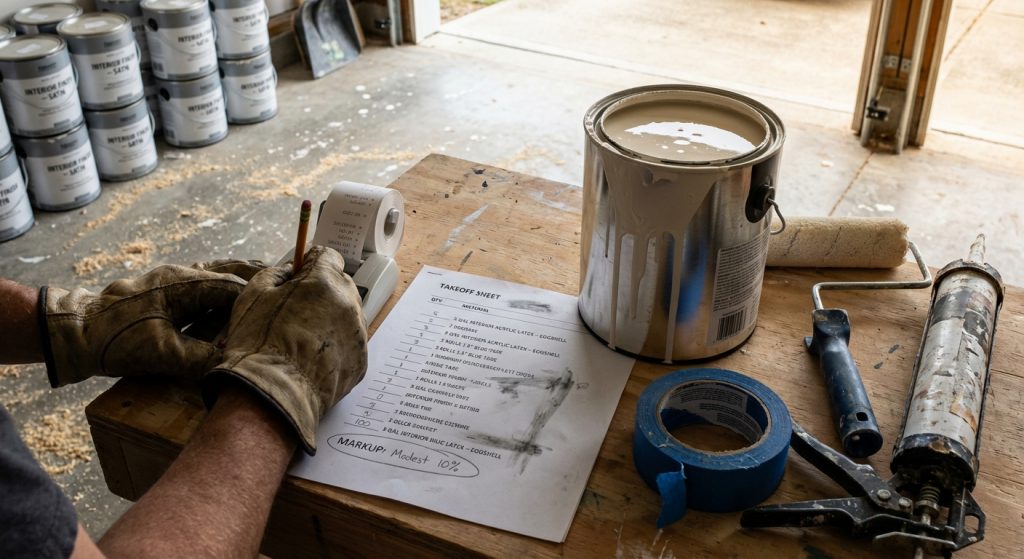
Materials and markup transparency
Paint and supplies typically account for 20% to 30% of the total project cost. The estimate should list materials separately so you can verify quantities and quality.
A standard paint calculation goes like this: one gallon of paint covers about 300 square feet with one coat. If your living room has 600 square feet of wall area and receives two coats, the painter needs four gallons. At $50 per gallon, that’s $200 in paint plus $40 in sundries (rollers, brushes, tape, trays). Total: $240.
Contractors mark up materials to cover procurement time, warranty support, and inventory risk. A fair markup is 10% to 20%. If the contractor buys $240 in materials and marks it up 15%, you pay $276. That’s reasonable and industry-standard.
Some contractors inflate markup to pad profit. If you see a 50% markup or materials priced far above retail, ask for an explanation. Transparency here builds trust and signals a contractor who operates above board.
When comparing bids, check the paint brand and product line. A bid quoting Behr Premium Plus at $40 per gallon is cheaper than one quoting Sherwin-Williams Emerald at $70 per gallon, but the latter delivers better coverage, durability, and washability. Lower material cost can mean lower quality, not better value.
Prep and repair unit pricing
Prep work is the wild card in most estimates. Minor prep is typically bundled into the labor rate, but significant repairs are quoted as separate line items.
Typical unit prices include:
- Drywall patch (small, under 2 inches): $15 to $30 each
- Drywall patch (large, over 2 inches): $50 to $150 each
- Caulking (per linear foot): $1 to $3
- Sanding (per hour): $50 to $75
- Priming (per square foot): $0.15 to $0.30
- Wood rot repair (per linear foot): $10 to $25
If your walls have extensive damage, ask the contractor to itemize repairs in the estimate. That prevents sticker shock when they discover issues mid-project.
Some contractors lowball the estimate by assuming minimal prep, then hit you with change orders once they start scraping and patching. Protect yourself by requesting a pre-project walk-through where the contractor documents existing damage and provides written repair costs before the job starts.
Coats, coverage, and color-change impacts
The number of coats directly impacts labor and materials. Two finish coats is standard for most repaints. If you’re making a drastic color change (dark blue over white or red over beige), you may need a tinted primer coat plus two finish coats.
Quick formula: Each additional coat adds roughly 30% to 50% to labor cost and doubles material cost for that surface. If your living room costs $600 to paint with two coats, adding a primer coat might bring the total to $750 to $900.
Sheen changes also matter. Moving from flat to semi-gloss requires extra sanding to smooth the surface so the sheen looks even. That adds labor time and material cost.
The estimate should state the number of coats for each surface and whether primer is included. If it’s silent on coats, assume the contractor plans one coat and you’ll need to negotiate for a second.
Add-ons, specialty services, and additional offerings
Common add-ons include:
Interior Painting Extras:
- Cabinets: $50 to $150 per door/drawer face (includes prep, priming, and two coats)
- Popcorn ceiling removal: $1 to $3 per square foot (plus disposal)
- Stair spindles: $3 to $10 each (hand-painting small surfaces is slow)
- Accent walls: May add $100 to $300 if they require masking or additional coats
Exterior Painting & Maintenance:
- High ceilings or tall walls: May add 20% to 50% for scaffolding or lift rental
- Exterior house washing (pre-paint prep): $300 to $800 for most homes
- Pressure washing services: $0.15 to $0.40 per square foot for driveways, patios, decks
- Gutter cleaning: $100 to $250 depending on linear footage and height
Commercial Services:
- Commercial painting (interior): $1 to $3 per square foot depending on surface prep and access
- Commercial painting (exterior): $0.80 to $2.50 per square foot; large warehouses at lower end
- Commercial cleaning contracts: Typically quoted monthly based on square footage and frequency
Residential vs. Commercial Pricing: Residential painting estimates typically run higher per square foot ($2-$5) due to detail work, color changes, and homeowner quality expectations. Commercial painting is often lower per square foot ($1-$3) but involves larger volumes and straightforward specs. Commercial cleaning estimates are structured around recurring service contracts rather than one-time projects.
If any of these services apply to your project, confirm they’re either included in the total or listed as optional extras. Some contractors bury them in the base rate, while others quote them separately to keep the headline price low.
Looking to refresh your home without the guesswork? We provide detailed, line-item estimates that show exactly where your money goes. Visit Paint and Clean MN to request a transparent quote today.
Hidden factors that swing price up or down
Estimates are built on assumptions. When those assumptions break, so does the price. The factors below are the ones homeowners underestimate most often. Understanding them helps you anticipate cost swings and avoid surprises.
Surface condition and previous coatings
The existing finish on your walls drives prep complexity. Smooth, well-maintained latex is the easiest base. Glossy oil-based paint, failing latex, smoke residue, water stains, or lead paint all require extra work.
Glossy oil-based paint needs sanding or a bonding primer to give the new latex something to grip. That adds a primer coat and extra sanding time.
Failing latex (peeling, cracking, or chalky) requires scraping and extensive patching. The contractor may need to remove large sections of loose paint, patch the underlying drywall, and prime before painting. That can add 30% to 50% to labor cost.
Smoke residue leaves a sticky film and persistent odor. It requires a stain-blocking primer like Kilz or Zinsser BIN to seal the surface. Skipping this step results in bleed-through and lingering smell.
Water stains and tannin bleed need stain-blocking primer too. If the estimate doesn’t mention it, the new paint won’t cover the stain.
Lead paint triggers regulatory requirements in homes built before 1978. If testing confirms lead, the contractor must follow EPA Lead-Safe protocols, which add cost and timeline. The estimate should state whether lead testing is included or excluded.
If your home has any of these conditions, expect the estimate to rise or ask the contractor to inspect and quote prep costs separately.
Color-change severity and paint quality tier
Painting the same color over itself is the cheapest option. Dramatic color changes add coats, primer, and labor.
Light-to-light or dark-to-dark repaints usually require two finish coats with minimal prep. Light-to-dark or dark-to-light changes often need a tinted primer coat to block the old color, plus two finish coats. That’s three total coats instead of two.
Paint quality also impacts coverage and durability. Standard paints from Behr, Valspar, or Glidden cover about 300 square feet per gallon and last five to seven years. Premium lines like Sherwin-Williams Emerald or Benjamin Moore Aura cover 400 square feet per gallon, resist stains better, and last eight to ten years.
When to upgrade: If you have high-traffic areas (hallways, kids’ rooms, kitchens), pets, or frequent cleaning needs, premium paint is worth the $0.50 to $1 per square foot upcharge. It resists scuffs and washes clean without losing sheen.
If longevity matters less (rental properties, short-term ownership, rarely used rooms), standard paint delivers acceptable results at lower cost.
Height, access, and safety requirements
Single-story projects are straightforward. Two-story exteriors, vaulted ceilings, and tall stairwells require ladders, scaffolding, or lifts, all of which add cost.
Ladders are cheapest but limit reach and slow productivity. Painters spend more time moving ladders than painting, so labor costs rise.
Scaffolding provides stable, wide work platforms for large areas. Rental and setup add $200 to $1,000 depending on project size. If your home needs scaffolding to reach the second story safely, the estimate should include it.
Lifts (boom lifts or scissor lifts) speed up exterior work on tall homes or multi-story buildings. Rental runs $300 to $800 per day, and the contractor needs insurance coverage for lift operation. Expect a 10% to 20% upcharge on exterior projects requiring lifts.
Safety regulations also impact cost. Commercial projects and projects over 6 feet require fall protection, which adds equipment and training costs. Residential contractors may roll this into their standard rate, but it’s worth confirming.
Weather, seasonality, and scheduling constraints
Weather dictates timing on exterior projects. Paint needs temperatures above 50 degrees and humidity below 85% to cure properly. That limits exterior work in northern climates to late spring through early fall.
High demand during peak season (May through September) drives prices up. Contractors can charge premium rates because homeowners compete for limited slots. If you schedule in late fall or early spring, you may negotiate a 10% to 15% discount because demand is lower.
Holiday scheduling also affects cost. Contractors charge more for work around major holidays because crews want time off. If you need the job done during Thanksgiving week or between Christmas and New Year’s, expect a surcharge or plan to wait.
Interior projects are less weather-dependent, but temperature still matters. If your home lacks climate control, paint won’t cure properly in freezing or extremely hot conditions. The estimate should note any weather-related delays or scheduling constraints.
Quick checklist: aligning scopes before you compare bids
Before you compare pricing, confirm every contractor is quoting the same project. Use this checklist to standardize scopes and eliminate apples-to-oranges confusion.
- Room list: Verify each bid covers the same rooms and areas. Check off every space and confirm inclusion or exclusion.
- Surface list: List walls, ceilings, trim, doors, and specialty items (cabinets, spindles, etc.). Make sure each bid addresses them.
- Paint brand and product line: Require exact brand, product line, and sheen. Generic terms like “premium paint” don’t count.
- Number of coats: Confirm two finish coats for walls, ceilings, and trim. Note any surfaces receiving fewer or more coats.
- Prep level: Define wash, scrape, sand, patch, caulk, and prime. Ask each contractor to state their standard prep protocol.
- Repair allowances: Set a threshold for included repairs (patches under 2 inches, maybe) and request unit pricing for anything beyond that.
- Primer type: Specify bonding, stain-blocking, or standard primer. Confirm where primer applies.
- Protection and cleanup: State expectations for floor protection, masking, daily cleanup, and waste disposal.
- Warranty term: Require a specific warranty period (two years labor and materials, for instance). Confirm what’s covered.
- Timeline and crew size: Ask for estimated start date, project duration, and crew size. Compare efficiency assumptions.
- Exclusions: List common exclusions (rotted wood, lead abatement, heavy furniture moving) and confirm each bid addresses them.
Send this list to every contractor before they submit a bid. It saves revision rounds and ensures you receive comparable proposals.
How to compare painting bids apples-to-apples
You’ve collected three bids, and the numbers are all over the map. One quotes $4,200, another $5,800, and the third $6,500. Without a framework, it’s impossible to know which represents fair value.
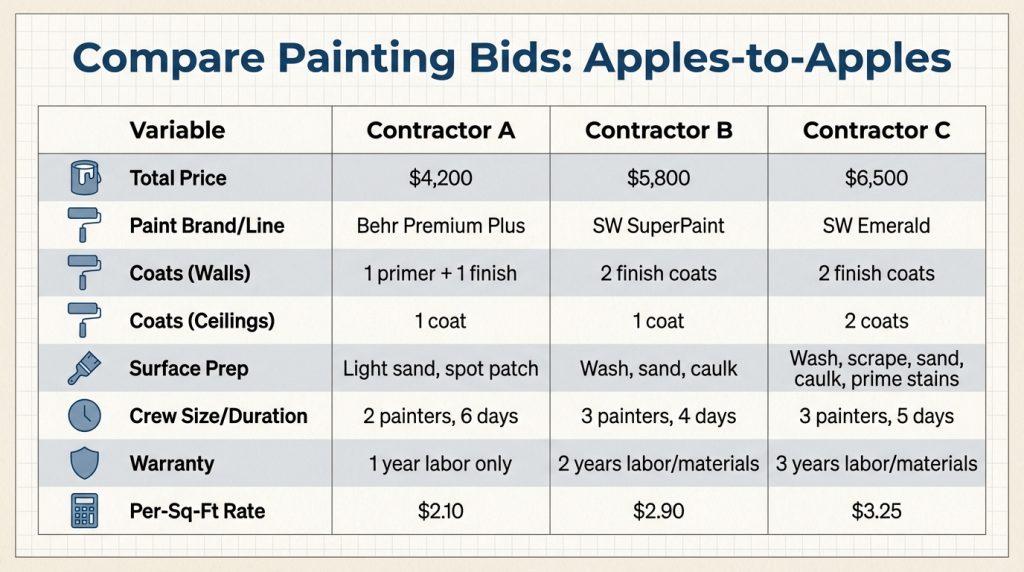
The table below shows how to decode three sample bids for the same 2,000-square-foot interior repaint. Each contractor quoted the project differently, so we broke down the key variables that explain the price spread.
| Variable | Contractor A | Contractor B | Contractor C |
|---|---|---|---|
| Total Price | $4,200 | $5,800 | $6,500 |
| Paint Brand/Line | Behr Premium Plus | SW SuperPaint | SW Emerald |
| Coats (Walls) | 1 primer + 1 finish | 2 finish coats | 2 finish coats |
| Coats (Ceilings) | 1 coat | 1 coat | 2 coats |
| Surface Prep | Light sand, spot patch | Wash, sand, caulk | Wash, scrape, sand, caulk, prime stains |
| Crew Size/Duration | 2 painters, 6 days | 3 painters, 4 days | 3 painters, 5 days |
| Warranty | 1 year labor only | 2 years labor/materials | 3 years labor/materials |
| Per-Sq-Ft Rate | $2.10 | $2.90 | $3.25 |
What the table reveals:
Contractor A is cheapest because they’re using lower-tier paint, applying fewer coats to ceilings, and delivering minimal prep. That bid will look great on day one but may fade, peel, or show imperfections within two years. The short warranty confirms the contractor isn’t confident in longevity.
Contractor B is mid-range. They’re using solid mid-tier paint (SW SuperPaint), applying two coats to walls, and delivering competent prep. The two-year warranty is standard. This bid represents fair value for a quality job that should last five to seven years.
Contractor C is the premium option. They’re using top-shelf paint (SW Emerald), applying two coats to ceilings for maximum coverage, and executing thorough prep including stain priming. The three-year warranty backs their work. This bid costs more but delivers the longest durability and best finish quality.
Decode the low bid without underbuying quality
Low bids feel like savings until you calculate the real cost. A contractor who quotes $2 per square foot by skipping a coat, using cheap paint, and rushing prep will leave you repainting in three years instead of seven. That’s not a savings. It’s deferred cost.
Common mistakes that create false savings:
- Missing second coat: Saves $800 on a 2,000-square-foot project but results in uneven coverage and early wear.
- Cheap paint: Saves $200 to $400 but fades faster, resists cleaning poorly, and requires touch-ups within two years.
- Minimal prep: Saves $500 but leaves rough spots, visible patches, and poor adhesion that leads to peeling.
- Short or no warranty: Signals the contractor won’t stand behind their work, so callbacks cost you extra.
If a low bid is tempting, ask the contractor to upgrade paint, add the second coat, and extend the warranty. If the adjusted price rises to match the mid-range bid, the original low bid was underpriced.
When a higher bid is worth it
Premium bids deliver value when you plan to stay in the home long-term, need high durability, or want the best finish quality.
Higher bids pay off when:
- You’re painting high-traffic areas or homes with kids and pets. Premium paint resists scuffs and cleans easily.
- You’re making a drastic color change. The extra primer and coats ensure complete coverage with no bleed-through.
- You want a flawless finish. Thorough prep and quality materials eliminate visible patches, rough spots, and uneven sheen.
- You value peace of mind. A three-year warranty means you won’t pay for callbacks or touch-ups if something fails.
Reframe the decision using cost-per-year. If a $6,500 bid lasts ten years and a $4,200 bid lasts five years, the premium option costs $650 per year while the budget option costs $840 per year. The premium bid is cheaper in the long run.
Use unit pricing to control change orders
Change orders are where estimates explode. A contractor who quoted $5,000 for the base project adds $1,200 in extras for repairs you didn’t anticipate. Protect yourself by requesting per-unit rates for likely extras before signing.
Template sentence you can use:
“Please include unit pricing in the estimate for the following items: drywall patches over 2 inches ($____ each), caulking ($____ per linear foot), priming stains ($____ per square foot), rotted trim replacement ($____ per linear foot). If these items are needed during the project, we’ll approve them at the pre-agreed rate.”
This language locks in fair pricing and prevents the contractor from inflating costs mid-project.
Payment schedule, deposits, and change orders
Money is trust made tangible. A fair payment schedule protects both you and the contractor by tying payments to completed milestones.
Typical payment milestones
Most contractors structure payments in three or four stages, each tied to measurable progress.
Common structures:
- Deposit: 10% to 25% upon contract signing to secure the schedule and purchase materials.
- Progress draw: 40% to 50% when prep is complete and first coat is applied.
- Second progress draw: 30% to 40% when finish coats are complete and cleanup is done.
- Final payment: 10% to 20% upon punch-list completion and client approval.
The exact percentages vary, but the principle is the same: you pay as work progresses, and you retain leverage until the job is done.
Avoid contractors who demand 50% or more up front. Large deposits signal cash-flow problems or the risk that your money funds someone else’s project. If a contractor insists on a large deposit for materials, ask for receipts showing your paint was purchased and stored for your job.
Deposits and material pre-purchase
A reasonable deposit is 10% to 25% of the total contract price. If your project costs $6,000, a $600 to $1,500 deposit is normal. That deposit covers the contractor’s time to schedule your project and order materials.
Some contractors ask for a larger deposit to pre-purchase premium or custom-color paint. That’s acceptable if they provide a receipt showing your materials were bought and stored on your behalf.
Warning: If a contractor demands 50% or more before work starts, that’s a red flag. You risk losing your deposit if they disappear, go out of business, or fail to complete the job. Pay the minimum necessary to secure your spot and release the rest as work progresses.
Change order process and documentation
Scope changes happen. You discover rotted trim that needs replacement, or you decide to add an accent wall mid-project. The estimate should define how these changes are priced, approved, and documented.
A solid change-order process includes:
- Written description of the new work
- Unit pricing or fixed cost for the addition
- Impact on timeline (adds one day, for example)
- Signature from both parties before work proceeds
Verbal change orders lead to disputes. If the contractor says “we can fix that for an extra $300,” ask them to write it down, sign it, and email it to you. That protects both sides.
Allowances and price adjustments
Some estimates include allowances for unforeseen repairs. An allowance is a budgeted amount for work that can’t be fully scoped until the project starts.
An estimate might state: “Drywall repair allowance: $500. If actual repairs exceed $500, additional work will be billed at $75 per hour. If repairs are under $500, the difference will be credited at final payment.”
Allowances prevent change-order surprises by setting expectations up front. At project closeout, the contractor reconciles the allowance. If they used $600 of a $500 allowance, you owe $100. If they used $300, you receive a $200 credit.
Clarify allowance terms before signing so you’re not caught off guard.
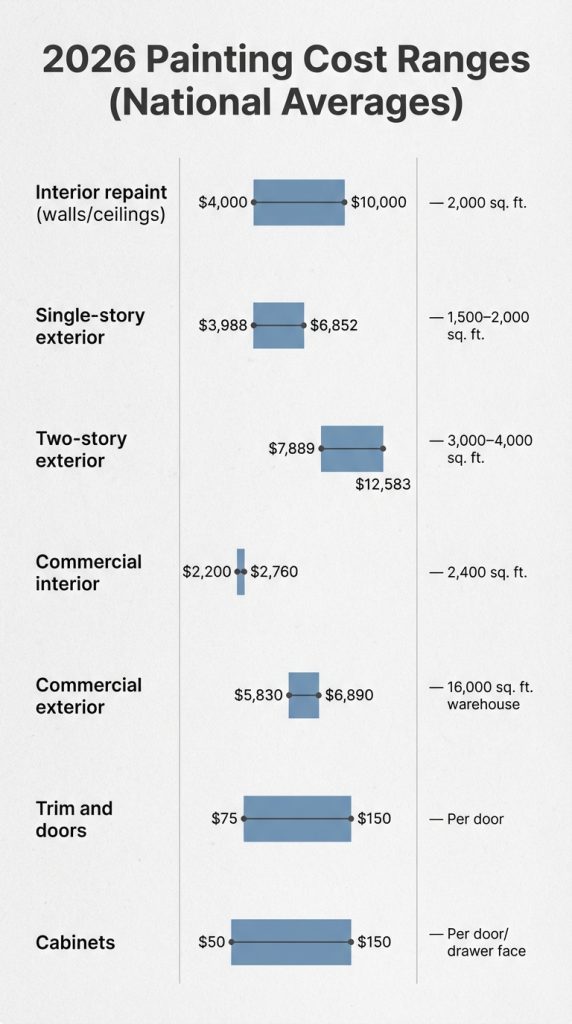
Regional and project-type cost ranges at a glance
Costs vary by location, project type, and complexity. The table below shows 2026 national averages for common projects. Adjust for your local market by checking recent bids or consulting local contractors.
| Project Type | Size/Description | National Cost Range | Notes |
|---|---|---|---|
| Interior repaint (walls/ceilings) | 2,000 sq. ft. | $4,000–$10,000 | $2–$5 per sq. ft.; high end includes premium paint, extensive prep |
| Single-story exterior | 1,500–2,000 sq. ft. | $3,988–$6,852 | $2–$6 per sq. ft.; varies by siding type, prep level |
| Two-story exterior | 3,000–4,000 sq. ft. | $7,889–$12,583 | $2–$6 per sq. ft.; adds scaffolding or lift costs |
| Commercial interior | 2,400 sq. ft. | $2,200–$2,760 | $1.08 per sq. ft.; smooth surfaces, minimal prep |
| Commercial exterior | 16,000 sq. ft. warehouse | $5,830–$6,890 | $0.82 per sq. ft. labor only; materials billed separately |
| Trim and doors | Per door | $75–$150 | Hand-painting small surfaces is labor-intensive |
| Cabinets | Per door/drawer face | $50–$150 | Includes prep, priming, two coats |
Interior repaint ranges (per sq ft and per room)
Interior projects range from $2 to $5 per square foot depending on prep level, color change, and whether ceilings are included.
Low end ($2/sq. ft.): Same-color refresh, minimal prep, standard paint, walls only.
Mid range ($3–$4/sq. ft.): Light color change, moderate prep, mid-tier paint, walls and ceilings.
High end ($5/sq. ft.): Drastic color change, extensive prep, premium paint, walls, ceilings, and trim.
Per-room pricing offers easier budgeting. A 12×12 bedroom (about 400 sq. ft. of wall area) costs $800 to $2,000 depending on finish quality and prep. A large living room (800 sq. ft.) costs $1,600 to $4,000.
Residential vs. Commercial Interior Painting:
Residential painting estimates prioritize finish quality, color accuracy, and homeowner satisfaction. Commercial painting focuses on durability, fast completion, and minimal business disruption. Commercial interior painting typically costs $1 to $3 per square foot for offices, retail spaces, and warehouses, lower than residential because specs are simpler and volumes are higher. However, commercial projects may require off-hours work (nights/weekends), which adds 15% to 30% to labor costs. Request separate commercial painting estimates if your project involves business property.
Exterior repaint ranges (by home size and complexity)
Exterior costs depend on siding type, elevation count, and access difficulty.
Single-story ranches: Easiest access, lowest labor cost. Expect $2 to $4 per square foot.
Two-story homes: Require ladders or scaffolding, adding 30% to 50% to labor. Expect $3 to $6 per square foot.
Multi-story or complex architecture: Turrets, gables, or three-story elevations need lifts and specialty equipment. Costs can exceed $6 per square foot.
Siding type also matters. Smooth vinyl or fiber cement is fastest to paint. Wood siding with peeling paint requires extensive scraping and priming. Stucco needs repair and sealing. The estimate should account for these differences.
Trim, doors, and detail items
Trim and doors are priced per unit or per linear foot because the work is meticulous.
- Baseboards: $1 to $3 per linear foot
- Crown molding: $2 to $4 per linear foot
- Interior doors: $75 to $150 each (both sides, including frame)
- Exterior doors: $100 to $200 each (includes weatherproofing)
Stair spindles run $3 to $10 each because they’re hand-painted and time-consuming. If your staircase has 40 spindles, that’s $120 to $400 in labor alone.
Cabinets and specialty finishes
Cabinet painting is labor-intensive. Each door and drawer face receives sanding, priming, and two finish coats. Spraying delivers the best finish but requires masking the entire kitchen.
Typical pricing:
- Per door/drawer face: $50 to $150 depending on size and finish quality
- Per linear foot of cabinetry: $30 to $60
Specialty finishes like glazing, distressing, or two-tone color schemes add 20% to 50% to labor cost.
Exterior maintenance and cleaning services cost ranges
Many painting contractors also offer exterior maintenance services that protect your investment between paint jobs. These services are often bundled with painting estimates for complete property refresh projects.
| Service Type | Typical Range | Notes |
|---|---|---|
| Exterior house washing | $300–$800 | Whole-home soft wash or pressure wash; essential pre-paint prep |
| Pressure washing (driveway/patio) | $150–$400 | $0.15–$0.40 per sq. ft.; concrete, pavers, stone |
| Deck pressure washing | $200–$500 | Includes cleaning and prep for staining if needed |
| Gutter cleaning | $100–$250 | Per cleaning; price varies by linear feet and home height |
| Commercial exterior cleaning | $500–$2,000+ | Depends on building size, surface types, accessibility |
Why bundle exterior house washing with painting?
Professional painters often recommend exterior house washing before any painting project. Washing removes dirt, mildew, chalk, and oxidation that prevent paint adhesion. If you’re getting an exterior painting estimate, ask whether house washing is included in the prep work or quoted separately.
Pressure washing as standalone service:
Even if you’re not painting, annual pressure washing extends the life of your siding, decks, driveways, and walkways by removing damaging buildup. Many contractors offer seasonal pressure washing packages for residential and commercial properties.
Gutter cleaning coordination:
Clogged gutters cause water damage that ruins paint and siding. Smart homeowners bundle gutter cleaning with exterior house washing to protect their investment. Ask your contractor if they offer package pricing for combined services.
Red flags and common mistakes when evaluating estimates
Not all estimates are created equal. Watch for these warning signs and buyer pitfalls.
Red flags:
- Vague scope: Estimate says “paint house” without listing rooms or surfaces.
- No product line: Lists “premium paint” without brand, line, sheen, or color ID.
- Missing prep: Doesn’t mention wash, scrape, sand, patch, caulk, or prime.
- No warranty: Either omits warranty entirely or offers less than one year.
- Oversized deposit: Demands 50% or more up front before work starts.
- Verbal-only agreement: Refuses to put scope, pricing, or timeline in writing.
- Rushed timeline: Quotes half the time other contractors estimated without explaining how.
- No insurance proof: Won’t provide certificate of general liability and workers’ comp insurance.
Common buyer mistakes:
- Choosing the lowest bid without comparing scope, coats, or paint quality.
- Skipping reference checks or online reviews.
- Paying in full before punch-list completion.
- Accepting verbal change orders without written documentation.
- Ignoring missing prep or single-coat specs to save money up front.
Warning: If a contractor won’t answer questions, avoids specifics, or pressures you to sign quickly, walk away. Quality contractors earn trust through transparency and patience.
Ready to work with a team that puts transparency first? At Paint and Clean MN, we deliver detailed estimates, answer every question, and stand behind our work with a solid warranty. Get your free quote today.
FAQ: what homeowners ask about estimates
Do painters include the paint?
Yes, professional estimates typically include materials unless specifically marked “labor only.” The estimate should list the paint brand, product line, sheen, and quantity so you can verify the contractor is delivering what they quoted. If the estimate is silent on materials, ask whether paint is included and request written confirmation. Some contractors offer a discount if you supply your own paint, but that shifts warranty risk to you. If the paint fails, the contractor may not cover rework.
How many coats are standard?
Two finish coats are the professional standard after proper priming or spot-priming. One coat rarely delivers full coverage or durability. Exceptions include same-color refreshes on well-maintained surfaces (where one coat may suffice) and drastic color changes (which may require a tinted primer plus two finish coats). The estimate should state the number of coats for walls, ceilings, and trim. If it’s silent, assume one coat and negotiate for two before signing.
Is primer included?
Primer is included when the surface requires it. Spot-priming patches, raw wood, and stain bleed-through is standard. Full-priming an entire room is less common on repaints unless you’re switching from oil-based paint to latex, covering drastic color changes, or sealing smoke or water damage. The estimate should specify primer type (bonding, stain-blocking, or standard) and where it’s applied. If primer isn’t mentioned, ask whether it’s included or billed separately.
Are touch-ups after move-in included?
Punch-list touch-ups before final payment are standard and should be included. Post-move-in touch-ups depend on the contractor’s policy. Some include one round of touch-ups within 30 days of completion to address settling cracks or missed spots. Others charge hourly for any work after final payment. The estimate should clarify what’s included and what’s billed. If you plan to move furniture back in immediately, ask the contractor to complete the punch list while the space is still clear.
Are color samples and test patches included?
Policies vary. Many contractors include one sample wall per color at no charge to help you finalize your choice. Additional sample walls or multiple test colors may be billed at $25 to $75 each. Sample quarts purchased at the paint store are usually your responsibility unless the contractor offers them as part of the service. Clarify the policy in the estimate so you’re not surprised by a charge for testing colors.
What’s the difference between residential painting and commercial painting estimates?
Residential painting estimates emphasize aesthetics, custom colors, and detail work for homeowners. They typically include extensive prep, multiple coats, and premium finishes. Commercial painting estimates focus on durability, speed, and cost efficiency for businesses. Commercial projects often use industrial-grade coatings, neutral color palettes, and streamlined processes to minimize downtime. Pricing differs too: residential runs $2 to $5 per square foot while commercial averages $1 to $3 per square foot due to larger scale and simpler specs. Both require different insurance, scheduling, and quality standards.
Do painting contractors offer pressure washing and gutter cleaning?
Many do. Exterior house washing, pressure washing, and gutter cleaning are common add-on services that painting contractors offer because they complement painting projects. Pressure washing is essential prep work before exterior painting—it removes dirt, mildew, and loose paint. Gutter cleaning prevents water damage that undermines fresh paint. Some contractors bundle these services with painting estimates at a package discount. Others quote them separately as standalone maintenance services. If you need exterior cleaning, ask your painting contractor whether they offer it in-house or can recommend a trusted partner.
Conclusion: choose the right painter with confidence
A great painting estimate isn’t just a price. It’s a roadmap, a contract preview, and a trust signal. When a contractor takes the time to itemize scope, specify materials, define prep standards, and explain pricing, they’re telling you they operate with integrity.
Armed with the framework above, you can decode any bid, spot missing details, and compare costs apples-to-apples. You’ll know when a low bid is a bargain and when it’s a risk. You’ll recognize when a higher bid delivers better value per year. And you’ll have the language to ask smart questions and negotiate fair terms.
Key Takeaway:
Request standardized, line-item estimates from every contractor. Compare scope, coats, prep level, paint quality, warranty, and timeline side by side. Use unit pricing to lock in fair rates for extras. Pay in stages tied to milestones. And trust the contractor who answers questions clearly, puts everything in writing, and stands behind their work with a solid warranty. That’s how you choose the right painter with confidence, avoid surprises, and get a finish that lasts.
Common add-ons include:
Interior Painting Extras:
- Cabinets: $50 to $150 per door/drawer face (includes prep, priming, and two coats)
- Popcorn ceiling removal: $1 to $3 per square foot (plus disposal)
- Stair spindles: $3 to $10 each (hand-painting small surfaces is slow)
- Accent walls: May add $100 to $300 if they require masking or additional coats
Exterior Painting & Maintenance:
- High ceilings or tall walls: May add 20% to 50% for scaffolding or lift rental
- Exterior house washing (pre-paint prep): $300 to $800 for most homes
- Pressure washing services: $0.15 to $0.40 per square foot for driveways, patios, decks
- Gutter cleaning: $100 to $250 depending on linear footage and height
Commercial Services:
- Commercial painting (interior): $1 to $3 per square foot depending on surface prep and access
- Commercial painting (exterior): $0.80 to $2.50 per square foot; large warehouses at lower end
- Commercial cleaning contracts: Typically quoted monthly based on square footage and frequency
Residential vs. Commercial Pricing: Residential painting estimates typically run higher per square foot ($2-$5) due to detail work, color changes, and homeowner quality expectations. Commercial painting is often lower per square foot ($1-$3) but involves larger volumes and straightforward specs. Commercial cleaning estimates are structured around recurring service contracts rather than one-time projects.
If any of these services apply to your project, confirm they’re either included in the total or listed as optional extras. Some contractors bury them in the base rate, while others quote them separately to keep the headline price low.
For a transparent estimate from the most reputable painting and cleaning contractor in Washington County, visit Fresh Start Paint & Clean.